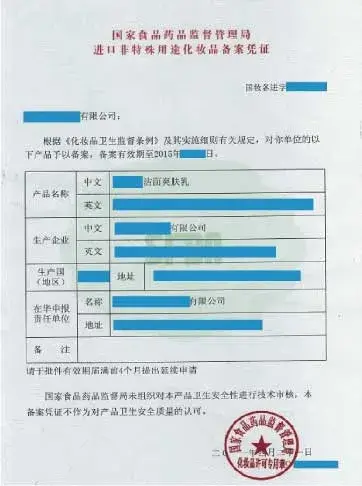





China License Qualification Certificate

Imported Cosmetics Record Certificate


Imported Cosmetics Record Certificate


To legally engage in the cosmetics business in Mainland China, enterprises must obtain the “Three Certificates for Cosmetics,” which include the Product Filing or Registration Certificate, Inspection Report, and Label Review Certificate. These documents are mandatory for the import, distribution, or introduction of new cosmetic ingredients. Without them, entering the Chinese market is virtually impossible and may lead to regulatory violations.

Similarly, operating in the Philippine cosmetics industry requires strict adherence to local laws. According to the Philippine Food and Drug Administration (FDA), all cosmetic products must follow the ASEAN Cosmetic Directive (ACD) under a Notification or Registration system. Businesses must first obtain a License to Operate (LTO) and then apply for either a Cosmetic Product Notification (CPN) or a Cosmetic Product Registration (CPR), depending on the product category, to legally import, distribute, and sell products.

大陸化妝品備案

I.Overview of Cosmetic Product Filing Certificate

  • The Chinese government continues to strengthen regulatory oversight on the sale of imported cosmetics. Whether sold through online platforms or physical retail channels, all imported cosmetic products are required to obtain official approval documents. As China’s cosmetics market rapidly expands, any enterprise intending to sell imported cosmetics in Mainland China must lawfully obtain the “Three Certificates for Cosmetics” — namely, the product registration or filing certificate, test report, and label review certificate. Companies must complete the registration and filing procedures in designated areas such as Shanghai or Shenzhen. Only after approval by the relevant regulatory authorities can they proceed with customs clearance, inspection, and initiate sales activities in compliance with the law. Imported cosmetics without the approval, can’t be customs declaration inspection declaration and sold in China.
  • Cosmetics favored by the consumers in the world, the early stage most of the Taiwanese businessman go in for cosmetics sales through mini-three links to China, there are more cosmetics companies operating in China, in order to protect the interests of enterprises and consumers, China government requires cosmetic goods must go through a formal declaration before sales.
  • Engaged in cosmetic business or new cosmetic raw material import and export enterprises or individuals must apply for a Cosmetics License, this document is valid credentials for each cosmetic product sales management, import, and export. With the reform of the market mechanism, the market economy is more standardized, the legal regime and cosmetic regulatory system more restored. The enterprises that want to engage in China, must apply “cosmetic license” otherwise can do nothing.
  • The Approval Document (commonly referred to as the “Pi Jian”) for cosmetics is issued individually for each specific product variant. Any change in product name or formulation is regarded as a new product and requires a separate application and the issuance of a new Approval Document. Each document corresponds to a unique approval number, which is valid only for the specific product to which it applies.For example, even if lotion products under the same brand share an identical base formula, if they contain different colorants (e.g., five color variations), five separate Approval Documents must be applied for, in accordance with the regulations. Similarly, if a brand launches eight different fragrances of the same perfume, eight individual Approval Documents are required.It is also important to note that under the current regulatory framework in China, there is no official product category recognized as “cosmeceuticals.” Therefore, products cannot be filed or approved under the label of “cosmeceutical.”
  • Inter Area has years of industry and commerce experience about applying for various China approval licenses, application of a cosmetic license is stricter than others in China. Inter Area has agent experience to apply for a cosmetic license and also provide agent form industry and commerce registration, China approval license and accounting service agent. Inter Area provides one-stop service of China company registration and professional personnel consultation, investors can be targeted at their businesses and be able to take care of industry and commerce issues for clients, so that investors can focus on business development.

II.The type of Cosmetic License in China

  • China Food and Drug Administration reviews the implementation of the declaration system for domestic special purposes and imported cosmetics (including special and non-special class).
  • Cosmetics declare SFDA health permit approval document (or registration certificate), reporting roughly divided into three categories, domestic special category, imports of special categories, import of non-special category:

Domestic special useful cosmetics

“China Food and Drug Administration domestic special purpose cosmetics health permit approval document.”
√ Applicant of the domestic cosmetics registration certificate license should be cosmetics manufacturers.
√ Applicant of the domestic cosmetics raw materials registration certificate license should be a cosmetic raw material manufacturer or cosmetics manufacturers.

化妝品公司元素

Imported special cosmetics

“China Food and Drug Administration import special useful cosmetics health permit approval document”.
√ Hair, Breasts, perm, body, dye, hair remover, deodorant, cream, sunscreen… are all part of a special class of imported cosmetics.

Imports of the non-special category of cosmetics:

“China Food and Drug Administration import non-special useful cosmetics for the record certificate”
√ Most of the applicants for the imported cosmetics record certificate are imported cosmetics manufacturers.
√ Hair type, skincare, makeup, nail (toe) CPI aromatic … are all part of an imported non-special category of cosmetics.

III.Document For Application in China

1. Apply for domestic special useful cosmetics shall submit the following information:

  • Domestic special useful cosmetics administrative license application form.
  • The basis of the product name.
  • Requirements for product quality safety control.
  • Design of product packaging. (including product labels, product brochures)
  • Inspection agency inspection report licensed by the State Food and Drug Administration issued identification and related information.
  • The provincial food and drug administration department issued an audit opinion the production of sanitary conditions.
  • Possible security risk assessment information relating to the safety of substances products.
  • Application of Hair, body, breast products, should be submitted ingredients and their use based on the scientific literature.
  • Attached provincial food and drug supervision and management departments sealed samples and one of the samples unseal.

II.Apply for Imported special cosmetics shall submit the following information:

  • Administrative license application form for import special cosmetics.
  • The basis of the Product’s Chinese name.
  • Product formulation.
  • Description and diagrams of the production process.
  • Requirements for product quality safety control.
  • Product original packaging (including product labels, product brochures); intended specifically for the China market design packaging, need to submit product design packaging at the same time (including product labels, product brochures).
  • Inspection agency inspection report licensed by the State Food and Drug Administration issued identification and related information.
  • Administration issued identification and related information.
  • Possible security risk assessment information relating to the safety of substances products.
  • Application of Hair, body, breast products, should be submitted ingredients and their use based on the scientific literature.
  • Copy of registered matter administrative licensing RRP authorization Letter in China, and a copy of administrative licensing business license RRP in China with an official seal.
  • Letter of undertaking for the requirement of ban cosmetic raw materials and sources of raw materials accord with a high-risk material BSE infected area.
  • Certificate of product’s sale and production in the producing country (region) or country of origin (region).
  • Additional information may help with administrative licensing.
  • Attached inspection organization sealed sample unbroken package for sale for 1.

III.Apply for an Imported non-special category of cosmetics shall submit the following information:

  • Administrative license application form for import non-special category of cosmetics.
  • The basis of Product’s Chinese name.
  • Product ingredients.
  • Requirements for product quality safety control.
  • Product original packaging (including product labels, product brochures);
  • Intended specifically for the China market design packaging, need to submit product design packaging at the same time (including product labels, product brochures).
  • The provincial food and drug administration department issued an audit opinion the production of sanitary conditions.
  • Possible security risk assessment information relating to the safety of substances products.
  • Copy of registered matter administrative licensing RRP authorization Letter in China, and the copy of administrative licensing business license RRP in China with an official seal.
  • Letter of undertaking for the requirement of ban cosmetic raw materials and sources of raw materials accord with a high-risk material BSE infected area.
  • Certificate of product’s sale and production in the producing country (region) or country of origin (region).
  • Attached inspection organization sealed sample unbroken package for sale for 1.

IV.Remark:

According to the latest requirements of the State Food and Drug Administration, after April 1, 2011, to declare cosmetic materials in addition to the above information, you must also submit the following information:
The requirement of cosmetic product technology. Applicants should be in accordance with “guidelines for the preparation of cosmetic products technical requirements” required to fill cosmetic product technical requirements and meet the following
requirements:

  • Only need to fill in Chinese Pinyin of the product name.
  • Formulation ingredients.
  • The production process should describe the complete production process, including the main steps and processes. organoleptic indicator.
  • The color, shape, smell description of the organoleptic indicator.
  • Hygienic chemistry indicators and microorganism indicators.
  • Cosmetic product technical requirements set forth in the use and storage conditions should be the same with cosmetics administrative licensing application materials product label or product specifications and storage conditions stated unanimously.
  • The shelf life of the product should be clearly stated shelf-life requirements, such as shelf-life ×× months (or × years).

IV.Inspection and Quarantine Procedures for Imported Cosmetics in China

  • Customs will examine each “document” for each product when imported cosmetics clearance. If there’s no prior declaration “document,” customs will not release.
  • Industry and commerce, quality inspection, hygiene and other department inspection in market enforcement, for no “document” cosmetics, can be destroyed, also impose a fine under the circumstances. Imported cosmetics consignee or his agent shall, in accordance with the relevant provisions of AQSIQ inspection, while providing the consignee for the record number.
  • In addition, the “document” is the only certificate of sale imported cosmetics legally in China, you should show the product’s “document” when regular mall, supermarkets, specialty store to purchase each product that you produce, otherwise it will be illegal.
  • Qualified inspection and quarantine of imported cosmetics, inspection and quarantine agencies issued “proof of entry inspection and quarantine of goods”, and list the name of the goods, brand, country of origin (region), size, number/weight, product batch number/production date. After imported cosmetics obtain “proof of entry inspection and quarantine of goods” can sales and use.
  • Under the “import and export inspection and quarantine supervision and management of cosmetic approach” (AQSIQ Decree No. 143), since February 1, 2012, imported cosmetics passed the test no longer be affixed to the inspection and quarantine of flag (CIQ).

V.Filing Certificate and Process for Non-Special Use Imported Cosmetics in China

化妝品證
  • Data preparation.
  • Authorization and recordation of the responsible unit of the declaration in China.
  • Sample verification.
  • CFDA application <record approval document>.
  • Imported cosmetics consignee filing.

VI.Philippine Cosmetic Licensing Procedures and Regulatory Requirements

  • In the Philippines, the regulation of cosmetics is overseen by the Food and Drug Administration (FDA). The management of cosmetic products follows a Notification System, in accordance with the ASEAN Cosmetic Directive (ACD). Under this framework, importers or manufacturers of cosmetic products are required to notify the FDA of product information. The purpose of notification is to inform the FDA of the product’s key details and ensure its safety. Registration, on the other hand, is a mandatory legal requirement for operating a business and involves more comprehensive compliance obligations.
    All imported cosmetics and those with special functions must obtain both a License to Operate (LTO) and a Certificate of Product Registration/Notification (CPR/CPN) from the FDA to be legally marketed in the Philippines. The typical process includes the following steps:
  • 1.Company Registration:The company must first be registered in the Philippines.
  • 2.Application for License to Operate (LTO): The company must apply for an LTO with the FDA, which is a prerequisite for lawful operations.
  • 3.Certificate of Product Registration (CPR/CPN):After obtaining the LTO, the company must apply for the appropriate product registration certificate based on the type of product.

General Cosmetics

Regulatory Documents:
LTO + CPN

Only online submission of product information is required; no technical review or clinical data needed. Fast approval time: typically 7–14 working days.

Imported Cosmetics

Regulatory Documents:
LTO + CPN

Must be submitted through a local company or agent holding a valid LTO. Notification is the same as general cosmetics, but import declaration is required.

Special Function Cosmetics (Medical-grade / Functional)

Regulatory Documents:
LTO + CPR

Products claiming therapeutic or functional effects (e.g., anti-acne, whitening) must submit safety and efficacy data, sometimes including clinical or lab data. Longer review time (3+ months).

VII.Philippines FDA Compliance Guide for Cosmetics: What are LTO, CPN, and CPR?

  • 1.License to Operate (LTO)
    -Definition:A license issued by the Philippine FDA to certify that a business (importer, manufacturer, distributor, etc.) is authorized to operate legally.
    -Function:It serves as the fundamental authorization for engaging in businesses related to cosmetics, pharmaceuticals, food, and similar products. Without an LTO, a company cannot legally apply for product registration or notification.
    -Scope of Application:All businesses involved in the importation, manufacturing, wholesale, or distribution of regulated products must apply. A separate LTO is required for each product category.
    -Validity:Applicants may choose a validity period of 1, 2, or 5 years.
  • 2.Cosmetic Product Notification (CPN)
    -Definition: A certificate for the notification of general low-risk cosmetic products (e.g., lotion, lipstick).
    -Function: The company submits product details (e.g., ingredients, safety information) to the FDA. Once approved, the FDA issues the CPN to confirm that the product has been notified and meets basic safety standards.
    -Scope of Application:Applicable to general cosmetics and products without therapeutic claims.
    -Application Requirements: The company must first obtain an LTO, then submit the list of ingredients and basic safety documentation.
    -Validity:Typically valid for 1 to 3 years, depending on the applicant’s selection.
  • 3. Cosmetic Product Registration (CPR)
    -Definition:A registration certificate required for cosmetics with special functions or active ingredients (e.g., whitening, anti-aging, sunscreen). Subject to in-depth technical review.
    -Function: The FDA conducts a comprehensive review of the product’s safety, efficacy, and supporting clinical data to ensure it meets higher regulatory standards.
    -Scope of Application:Applicable to medical-grade cosmetics or products that claim therapeutic or functional effects.
    -Application Requirements:The company must first obtain an LTO, and then submit a complete Product Information File (PIF), clinical trial data, and safety assessments.
    -Validity:Initial registration is valid for 3 years and may be renewed for up to 5 years.

VIII. Import Procedures and Regulatory Compliance Requirements for Cosmetics in Singapore

Singapore is well known for its transparent and highly international regulatory framework. Nevertheless, cosmetic products must comply with clearly defined regulatory and compliance requirements prior to importation and sale.Cosmetics in Singapore are primarily regulated by the Health Sciences Authority (HSA) in accordance with the ASEAN Cosmetic Directive (ACD).

Basic Company and Customs Requirements for Importing Cosmetics.

To import cosmetics into Singapore for sale or distribution, a Singapore-registered company must first satisfy the following prerequisites :

  1. Company Registration and UEN :
    The company must be registered with the Accounting and Corporate Regulatory Authority (ACRA) and obtain a Unique Entity Number (UEN).
  2. Activation of Customs Account:
    Upon obtaining the UEN, the company must activate its customs account. Without an activated account, the company will not be eligible to engage in import or export activities.

Cosmetic Product Notification.
Basic Notification Requirements :

  • Before any cosmetic product is placed on the market, the importer (or manufacturer, wholesaler, or retailer) is required to submit a Cosmetic Product Notification via HSA’s online system, PRISM.
  • Even if a product has already been notified by another company, any variation in formulation, fragrance, or shade requires a separate notification. Products may only be legally sold or distributed after the notification has been successfully submitted and acknowledged by HSA. For products that remain on the market, companies must periodically reconfirm their notifications as required by HSA and promptly update or resubmit notifications if any product information changes.

Ingredient, Safety, and Labelling Compliance Requirements :

  1. Ingredients and Product Safety.
    Cosmetic formulations must not contain substances prohibited under Annex II of the ACD. Restricted substances listed in Annex III must comply with specified conditions of use and concentration limits. Preservatives, colorants, and UV filters may only be used if they appear on the ACD’s permitted lists.
    Prior to importation, companies should conduct a thorough ingredient compliance review. Even products legally sold in other countries may not be eligible for sale in Singapore if they do not comply with ACD requirements.
    Companies must also prepare and maintain a Product Information File (PIF), which typically includes full ingredient and formulation details, safety assessment documentation (where applicable), and manufacturing and quality-related records. The PIF does not need to be submitted in advance, but HSA may request it during inspections, in response to complaints, or in the event of safety concerns.
  2. Product Labelling Requirements.
    All cosmetic products sold in Singapore must be labelled in English (bilingual labelling is permitted) and must clearly display the following information :
    • Product name and intended function
    • Ingredient list (INCI names, listed in descending order)
    • Net Content (weight or volume)
    • Country of manufacture
    • Batch number
    • Manufacturing date or expiry date (if shelf life is less than 30 months)
    • Name and address of responsible company in Singapore
    • Required warnings or precautionary statements (where applicable)

    Labelling may be affixed be affixed after importation but must be completed before the product is made available for sale to consumers.

  3. Advertising and Claims Restrictions 
    Cosmetic advertising and marketing claims must not imply any medical or therapeutic effects, such as the treatment or prevention of diseases or medical conditions. All claims must remain within the acceptable scope of cosmetic functions,  such as cleansing, care, or enhancement of appearance, and must be supported by reasonable and scientifically substantiated evidence.
    HSA may request supporting documentation to verify the accuracy and legitimacy of any claims made.

Imported Cosmetics License:
Frequently Asked Questions Q&A

Q1. What is the application for the three certificates of cosmetics in China?

  • In fact, the so-called “Three Certificates” for cosmetics in mainland China refer to the three certificates that must be applied for by cosmetics companies operating in mainland China, including the Cosmetics Filing Certificate, the Customs Registration Certificate, and the Self-Reporting Inspection Enterprise Filing Certificate. These three certificates, which are required for importing cosmetics into China, are collectively referred to as the “Three Certificates for Cosmetics”. In order to simplify the approval process, China has introduced a “three certificates in one” policy in recent years. Inter Area has professional talents who understand the needs of client companies, and has substantial experience in applying for cosmetics filing in mainland China. We can help clients save time and costs by handling the application process for the “Three Certificates for Cosmetics” in mainland China, facilitating their cosmetic business operations in China.

Q2. What should I do if the cosmetics originally imported from the small three links to China are stuck in customs?

  • The reason why cosmetics imported from Taiwan via the “Small Three Links” are being held up in China is mainly because the Chinese government wants to return to normal customs declaration procedures. Therefore, companies wishing to sell cosmetics in China must go through the normal customs declaration process to import their goods for sale in China. 【Small Three Links Information】

Q3. How long does it take to apply for cosmetic certificate filing in China?

  • To import a single cosmetic product into China, a cosmetics filing must be made and the product needs to undergo an 8-month sample testing process. Only after passing the testing will a testing report be issued. Even if the same product has different ingredients or colors, it is still considered a different product and requires a separate cosmetics filing.

Q4. What is the responsible unit in China?

  • Each cosmetic product exported to China can only be authorized to one agent, and the agent must be an independent legal entity in China. The responsible unit in China refers to the agent company in China. When importing cosmetics into China, the agent needs to submit the product for unit testing of the cosmetics importation, meaning that the choice of agent company must be either an enterprise established by the investor themselves or a cooperative enterprise in China.

A: In fact, the so-called “Three Certificates” for cosmetics in mainland China refer to the three certificates that must be applied for by cosmetics companies operating in mainland China, including the Cosmetics Filing Certificate, the Customs Registration Certificate, and the Self-Reporting Inspection Enterprise Filing Certificate. These three certificates, which are required for importing cosmetics into China, are collectively referred to as the “Three Certificates for Cosmetics”. In order to simplify the approval process, China has introduced a “three certificates in one” policy in recent years. Inter Area has professional talents who understand the needs of client companies, and has substantial experience in applying for cosmetics filing in mainland China. We can help clients save time and costs by handling the application process for the “Three Certificates for Cosmetics” in mainland China, facilitating their cosmetic business operations in China.

A: The reason why cosmetics imported from Taiwan via the “Small Three Links” are being held up in China is mainly because the Chinese government wants to return to normal customs declaration procedures. Therefore, companies wishing to sell cosmetics in China must go through the normal customs declaration process to import their goods for sale in China. 【Small Three Links Information】

A: To import a single cosmetic product into China, a cosmetics filing must be made and the product needs to undergo an 8-month sample testing process. Only after passing the testing will a testing report be issued. Even if the same product has different ingredients or colors, it is still considered a different product and requires a separate cosmetics filing.

A: Each cosmetic product exported to China can only be authorized to one agent, and the agent must be an independent legal entity in China. The responsible unit in China refers to the agent company in China. When importing cosmetics into China, the agent needs to submit the product for unit testing of the cosmetics importation, meaning that the choice of agent company must be either an enterprise established by the investor themselves or a cooperative enterprise in China.

Related topics